Current Access Level “I” – ID Only: CUID holders, alumni, and approved guests only
Campus open to active affiliate Columbia University ID (CUID) holders and approved guests only.
Columbia students, faculty, and staff can use the guest registration portal to register up to two same-day guests. Alumni can use the portal to register for campus same-day access as well. Learn more below.
This website uses cookies as well as similar tools and technologies to understand visitors’ experiences. By continuing to use this website, you consent to Columbia University’s usage of cookies and similar technologies, in accordance with the Columbia University Website Cookie Notice.
The Center on Global Energy Policy (CGEP) at Columbia University SIPA today announced the fourth cohort of the David Leuschen Global Energy Fellows. The cohort, which consists of...
Announcement• February 11, 2026
Energy Explained
Get the latest as our experts share their insights on global energy policy.
Iran has among the world's largest natural gas resource bases, but its ability to supply regional and global markets is constrained by sanctions, underinvestment, and limited export infrastructure.
The Trump administration has prioritized nuclear energy expansion, aiming to increase US nuclear capacity fourfold by 2050. This nuclear energy resurgence in the US is a rare issue...
This workshop will be conducted in two parts: Part one on February 16 from 1:00 PM to 2:00 PM EST, and Part two on February 18 from 1:00 PM to...
Event
• Center on Global Energy Policy
1255 Amsterdam Ave, New York, NY 10027
About Us
We are the premier hub and policy institution for global energy thought leadership. Energy impacts every element of our lives, and our trusted fact-based research informs the decisions that affect all of us.
Center on Global Energy Policy Announces Fourth Cohort of David Leuschen Global Energy Fellows
February 11, 2026
Share
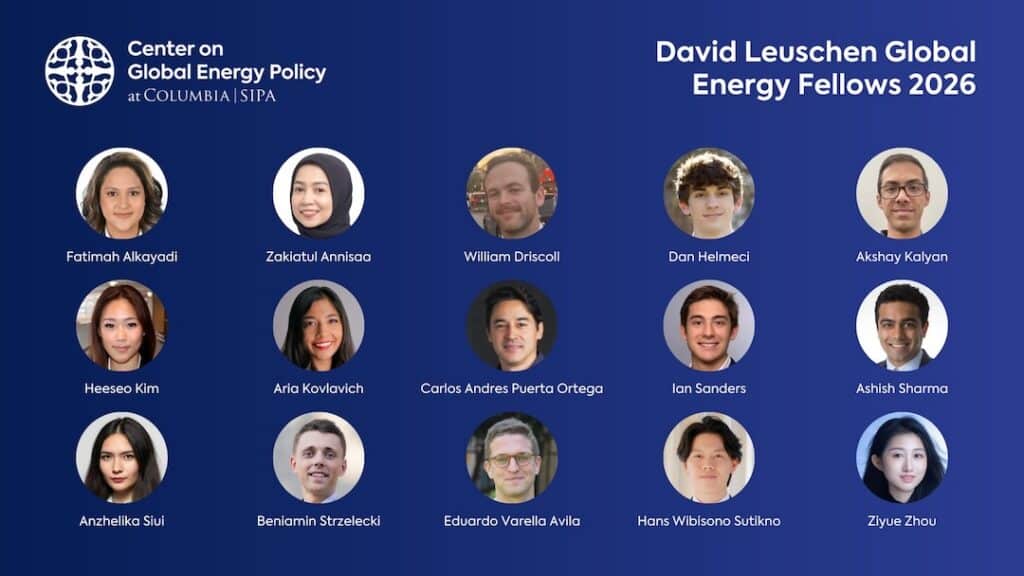
The Center on Global Energy Policy (CGEP) at Columbia University SIPA today announced the fourth cohort of the David Leuschen Global Energy Fellows. The cohort, which consists of Columbia University graduate students, will participate in monthly programming and learning sessions with energy leaders and scholars, receive networking and career support, and take part in curated events and career development opportunities. For the first time, fellows in this cohort will each be individually paired with a CGEP scholar. They will serve as research assistants to the scholars, supporting them with the writing of research products and facilitating the Center’s convenings of policymakers and stakeholders in the energy policy community.
“In an era of heightened geopolitical uncertainty and rapid change in the global energy system, the ability to understand how energy policy intersects with geopolitics and national security is essential,” said Jason Bordoff, Founding Director of CGEP.“Through the David Leuschen Global Energy Fellows Program, the Center equips Columbia graduate students with the analytical tools, policy expertise, and professional networks needed to confront today’s energy challenges and to help shape a more secure and sustainable global energy future.”
The David Leuschen Global Energy Fellows program is open to full-time graduate students (including PhD candidates) who are enrolled at Columbia University for the duration of the program. Fellows are matched with CGEP Senior Research Scholars or Global Fellows for individualized collaboration. Fellows are compensated for up to 10 hours as Student Research Workers.
“In the United States and across the globe, energy is central to a range of policy challenges that will have huge ramifications for citizens, governments, and businesses,” said David Leuschen.“The Global Energy Fellows program will provide best-in-class training and networking opportunities for promising individuals who can find the solutions to those challenges. I am pleased to join the Center on Global Energy Policy to support future energy leaders with the extraordinary talent Columbia University has to offer.”
This year’s David Leuschen Global Energy Fellows can be found below:
Akshay Kalyan, Columbia University School of International and Public Affairs
Anzhelika Siui, Columbia University School of International and Public Affairs
Aria Kovlavich, Columbia University School of International and Public Affairs
Ashish Sharma, Columbia University School of Professional Studies
Beniamin (Benji) Strzelecki, Columbia University School of International and Public Affairs
Carlos Andres Puerta Ortega, Columbia University School of International and Public Affairs
Dan Helmeci, Columbia University School of International and Public Affairs
Eduardo Varella Avila, Columbia University School of International and Public Affairs
Fatimah Alkayadi, Columbia University School of International and Public Affairs
Hans Wibisono Sutikno, Columbia University School of Professional Studies
Heeseo Kim, Columbia University School of Professional Studies
Ian Sanders, Columbia University School of International and Public Affairs
Kailey Kimsa, Columbia Climate School
William Driscoll, Columbia University School of International and Public Affairs
Zakiatul Annisaa, Columbia University School of International and Public Affairs
“Any additional volatility in pipeline flows from Iran to Turkey would deepen Turkey’s bid in the Atlantic basin LNG market, diverting incremental cargoes from northwest Europe,” said Benjamin Gage, founder of Balance Point Research. This would likely result in higher European benchmark TTF prices, with the market needing to “reprice higher to protect its share of flexible LNG supply”, he added. American and Iranian diplomats held a first round of negotiations in Oman on Friday, easing immediate fears of escalation, although there was no decisive breakthrough, including around Iran’s nuclear programme. Turkey imported around 22mcm/day of natural gas via pipeline from Iran in 2025, Gage said,
Iran has among the world's largest natural gas resource bases, but its ability to supply regional and global markets is constrained by sanctions, underinvestment, and limited export infrastructure.
The decline of domestic fossil fuel production in the United States poses serious economic risks for communities that rely on fossil fuel industries for jobs and public revenues. Many of these communities lack the resources and capacity to manage those risks on their own. The absence of viable economic strategies for affected regions is a barrier to building the broad, durable coalitions needed for an equitable national transition to cleaner energy sources.
The United States is at a rare inflection point for nuclear energy, with unprecedented momentum behind deployment and regulatory reform as nuclear becomes central to energy security, AI competitiveness, and state and corporate climate goals.