Current Access Level “I” – ID Only: CUID holders, alumni, and approved guests only
Read more about the campus status level system and campus access information.
This website uses cookies as well as similar tools and technologies to understand visitors’ experiences. By continuing to use this website, you consent to Columbia University’s usage of cookies and similar technologies, in accordance with the Columbia University Website Cookie Notice.
The Resilient Energy Economies initiative (REE) is pleased to announce that it is funding six new research projects to help US fossil fuel-dependent communities diversify and strengthen their...
Announcement• March 9, 2026
Energy Explained
Get the latest as our experts share their insights on global energy policy.
On February 28, the United States and Israel launched a campaign against Iran targeting military infrastructure and the regime's core leadership. Supreme Leader Ayatollah Ali Khamenei and several...
Join us for an in-person event exploring careers and opportunities in the rapidly evolving electric vehicle and sustainable transportation ecosystem.
Event
• International Affairs Building, 15th Floor
Columbia University
About Us
We are the premier hub and policy institution for global energy thought leadership. Energy impacts every element of our lives, and our trusted fact-based research informs the decisions that affect all of us.
The Resilient Energy Economies Initiative Announces Six Research Grants to Support Fossil Fuel-Dependent Communities
March 9, 2026
Share
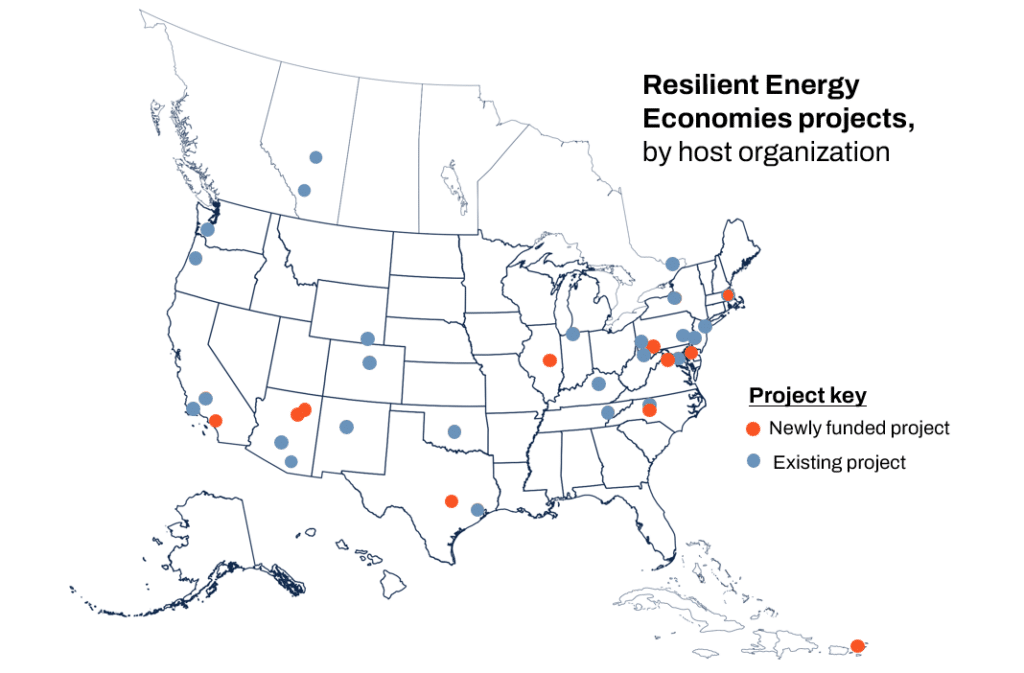
The Resilient Energy Economies initiative (REE) is pleased to announce that it is funding six new research projects to help US fossil fuel-dependent communities diversify and strengthen their economies as the energy system transforms. The projects will explore timely issues in fossil-dependent regions across the country:
Testing effective community engagement models for energy transition planning in three Texas and Michigan communities
Identifying new economic development opportunities for the Navajo Nation, the Hopi Tribe, and the broader Four Corners region
Analyzing the workforce impacts of potential investments, such as data centers and battery manufacturing, in southwest Pennsylvania
Examining how Illinois communities are using a state grant program to navigate the shift from fossil fuels
Evaluating how operational uncertainty at a refinery in St. Croix, US Virgin Islandsimpacts workers and communities
Comparing planning approaches and economic outcomes for two upcoming refinery closures in Los Angeles County and Benicia, CA
These projects are driven by local and regional needs and speak directly to ongoing economic transition efforts across the country. The projects focus on communities across the fossil fuel value chain, including those hosting coal and natural gas extraction, refining, and power plant operations.
REE has committed roughly $450,000 to support these projects, adding to the $1.8 million it committed to 22 research projects in 2023 and 2024. REE selected the six new projects from nearly 80 grant proposals submitted by research teams across 33 US states and Canada. The projects will be completed over the next two years. REE anticipates that results from the projects will begin to surface in mid-2027. More information on the winning grants and grantees is listed below.
REE is co-led by scholars from Resources for the Future, the Center on Global Energy Policy at Columbia University SIPA, the University of Notre Dame, and Montana State University. The Alfred P. Sloan Foundation provided funding for these research projects. REE also receives significant input from its academic steering committee and policymaker advisory board, both of which include experts from fossil-producing regions across the country, such as West Virginia, Wyoming, and elsewhere.
For more information about REE, its work, and the grants, visit ResilientEnergyEconomies.org. To stay up to date on these projects and their findings, subscribe to REE’s newsletter.
Reach out to REE project manager Christina Cilento ([email protected]) with questions and Annie Tastet ([email protected]) with press inquiries.
Funded Projects
Building Transition Readiness: Comparing Engagement Models for Early-Stage Capacity in Fossil Fuel Communities: Communities facing fossil fuel asset retirements often lack the foundational capacity—trust, networks, and collective agency—needed to participate meaningfully in transition planning. This project directly builds that early-stage capacity in three communities (Elmendorf, TX; La Grange, TX; and Lansing, MI) through structured engagement interventions that compare two facilitation models. The results will strengthen communities’ coordination infrastructure while generating rigorous evidence on what works to inform regional policymakers and other decisionmakers.
John Cornwell, Erik Funkhouser, Julia Sweatman, Dilge Kanoglu, and Pedro Garza (Good Energy Collective); Donnie Sackey (University of Texas at Austin); Lisa Marshall (North Carolina State University); Ariane Beck (independent)
Enhancing Four Corners Economic Resilience and Tribal Sovereignty: This collaborative project provides economic analysis and capacity building to enhance cross-government coordination between the Navajo Nation, the Hopi Tribe, and the State of Arizona. The project aims to present new opportunities for job and revenue creation within coal-dependent communities and across the Four Corners region more broadly. Focusing on challenges and opportunities identified by the two tribes with support from the State of Arizona, the project introduces tools, expertise, and capacity to understand and assist with the transformation of the Four Corners economy.
Ricardo Hausmann, Tim O’Brien, Juan Carlos Orrego, Tim Freeman, and Eric Henson (Harvard University); Sharlene Begay-Platero (Navajo Nation); Jamie Kootswatewa (Hopi Tribe); Maren Mahoney, Kayla Lucero-Matteucci, Jason Chavez, and EJ John (Office of the Arizona Governor)
Understanding Workforce Impacts of Candidate Investments in Energy Communities, with an Application to Southwest Pennsylvania: This project aims to characterize and quantify the workforce and income impacts associated with energy and manufacturing investment options in southwest Pennsylvania, including data centers, battery manufacturing, and other industries. The results will facilitate comparisons of investments in southwest Pennsylvania based on their job creation potential and associated uncertainties. The methodology the project demonstrates can then be applied to any industry and location, to inform decisionmakers’ consideration of candidate investments beyond southwest Pennsylvania.
Valerie Karplus, Christophe Combemale, and Jillian Miles (Carnegie Mellon University)
Understanding Coal Community Resilience through Illinois’s Energy Transition Community Grant Program: This project examines how Illinois communities are using the state’s Energy Transition Community Grant Program, a flexible funding opportunity created under Illinois’s 2021 Climate and Equitable Jobs Act, to navigate the shift away from coal and other fossil fuels. By combining stakeholder interviews in participating communities with administrative data analysis, the project explores how local governments, organizations, and residents utilize flexible funding to support economic diversification, infrastructure development, and long-term planning.
Roshan Krishnan, Johnathan Hettinger, Linda Derhak, Emily Guske, and Linda Larsen (University of Illinois at Urbana-Champaign)
Economic Transition, Recovery, and Resilience in the Post-Refinery Era: St. Croix, US Virgin Islands: This project examines how fossil fuel–dependent communities plan for economic resilience when the future of major industrial assets is uncertain. Focusing on the St. Croix refinery in the US Virgin Islands, the research analyzes how the refinery’s 2012 shutdown, 2021 license to operate (later rescinded), and ongoing restart uncertainty have affected jobs, household income strategies, public revenues, and government decisionmaking. The project also compares alternative future pathways, including continued closure, partial restart, and full restart, to clarify trade-offs between short-term economic gains and long-term stability.
Kalim Shah (University of Delaware); Gregory Guannel (University of the Virgin Islands)
Evaluating Economic Resilience and Institutional Capacity in California’s Refinery Closures: This project examines how state and local governments and labor organizations implement and coordinate transition planning and workforce supports during refinery closures, and the extent to which these efforts mitigate economic impacts on affected workers and communities. Focusing on two refinery closures in California (Phillips 66 in Wilmington and Carson and Valero in Benicia), the study uses displaced worker surveys, fiscal analyses, and interviews with institutional actors and affected workers to investigate why similar industrial closures can produce different economic outcomes across communities.
Nicola Ulibarri and Sage Kime (University of California, Irvine); Ranjit Deshmukh (University of California, Santa Barbara)
The Institute of Global Politics (IGP) and Center on Global Energy Policy (CGEP) at Columbia SIPA today announced a new task force focused on analyzing how tools of...
As the train pulls away from Davos Dorf station through the snow-capped Swiss mountains, I find myself reflecting on a rather extraordinary week at the World Economic Forum’s Annual Meeting in Davos. While many questioned Davos’ continuing relevance last year, it is difficult to argue that this year’s gathering was not among the most consequential in recent memory, shaped in large part by President Trump’s dominant presence throughout the week’s discussions.
The decline of domestic fossil fuel production in the United States poses serious economic risks for communities that rely on fossil fuel industries for jobs and public revenues. Many of these communities lack the resources and capacity to manage those risks on their own. The absence of viable economic strategies for affected regions is a barrier to building the broad, durable coalitions needed for an equitable national transition to cleaner energy sources.
On November 6, 2025, in the lead-up to the annual UN Conference of the Parties (COP30), the Center on Global Energy Policy (CGEP) at Columbia University SIPA convened a roundtable on project-based carbon credit markets (PCCMs) in São Paulo, Brazil—a country that both hosted this year’s COP and is well-positioned to shape the next phase of global carbon markets by leveraging its experience in nature-based solutions.