This website uses cookies as well as similar tools and technologies to understand visitors’ experiences. By continuing to use this website, you consent to Columbia University’s usage of cookies and similar technologies, in accordance with the Columbia University Website Cookie Notice.
Many analyses of what the conflict in the Middle East means for China's energy security have rightly focused on China's oil and natural gas imports from the region.
Despite all the advancements we have achieved globally in recent decades, as many as 750 million people still lack access to electricity. Tackling energy poverty requires far more...
We are the premier hub and policy institution for global energy thought leadership. Energy impacts every element of our lives, and our trusted fact-based research informs the decisions that affect all of us.
The Center on Global Energy Policy (CGEP) at Columbia University SIPA today announced three new distinguished visiting fellows, Rania Al-Mashat, Jonathan Black, and Dan Brouillette, who will bring...
Panel to be Chaired by Former President of Chile Michelle Bachelet Top Energy, Finance, Industry, Philanthropy, and Government Leaders to Examine Pathways to Drive Energy Development in Low-...
The Resilient Energy Economies initiative (REE) is pleased to announce that it is funding six new research projects to help US fossil fuel-dependent communities diversify and strengthen their...
The Institute of Global Politics (IGP) and Center on Global Energy Policy (CGEP) at Columbia SIPA today announced a new task force focused on analyzing how tools of...
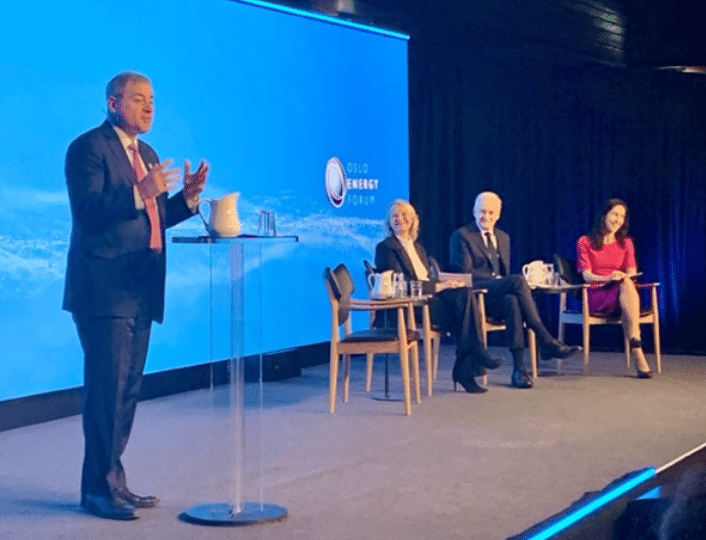
I’m en route home after a week in Europe—first at the Oslo Energy Forum and then at the Munich Security Conference. Munich generated considerable news and drama, but...
Get the latest news and research on energy & climate policy.
Op-Eds, Essays, In the News & Announcements
All News
Artificial Intelligence
Climate Change
Critical Minerals
Energy for Development
Energy Justice
Energy Markets
Energy Policy
Energy & Public Health
Energy Security
Finance & Economics
Fossil Energy
Geopolitics
Hydrogen
Industrial Decarbonization
Innovation & Technology
Natural Gas
Nuclear Energy
Oil
Power Sector
Renewable Energy
Trade Policy
Transportation
Asia + Pacific
China
Europe
India
Latin America
Middle East + North Africa
Sub-Saharan Africa
North America
Russia
Reports
Commentary
Op-eds & Essays
Testimonies & Speeches
Task Force Reports
White Papers
Q&A
Datasets
Summaries
Fact Sheet
Books
External Publications
Blog
Europe and Asia are facing fuel shortages. The U.S. is in a fuel deficit. Some experts say the Iran War has caused the largest energy security threat in history. And it's about to get worse.
Russian President Vladimir Putin is visiting China this week for the 25th time, but he meets his Chinese counterpart Xi Jinping with the two countries in mismatched diplomatic and economic standing.
Eric Goff, founder of Goff Policy on batch zero, transmission planning, and how Texas can serve new load without shifting costs onto existing customers.
The material may be most closely associated with fast fashion, but high-end labels depend on it heavily because of its versatility. Theyâre not giving it up, even as surging fossil fuel prices push up costs.
Jason Bordoff from Columbia University, formerly at the US National Security Council under the Obama administration, says Iran has high tolerance for navigating the impact of the Strait of Hormuz closure. He also says global inventories and rerouted fuel flows are temporarily cushioning the disruption from the war, but warns prices will rise sharply once those buffers run down and demand destruction sets in.
The summit follows Xi Jinping's meeting with US President Donald Trump and is expected to cover future energy cooperation, Ukraine, and the war in Iran.