This website uses cookies as well as similar tools and technologies to understand visitors’ experiences. By continuing to use this website, you consent to Columbia University’s usage of cookies and similar technologies, in accordance with the Columbia University Website Cookie Notice.
Energy Explained
Get the latest as our experts share their insights on global energy policy.
The US Is Internationalizing Its Critical Minerals Industrial Policy
Securing critical minerals is a top priority of governments around the world.
Podcasts
Hear in-depth conversations with the world’s top energy and climate leaders from government, business, academia, and civil society.
Alex Fitzsimmons on the DOE’s ‘Energy Dominance’ Agenda
Under the second Trump administration, the US Department of Energy significantly shifted its priorities to align with its “energy dominance" agenda. But one significant point of continuity with...
Events
Find out more about our upcoming and past events.
February 25, 2026
• 12:00 pm - 1:00 pm
est
Energy Markets and the Future of Energy with Amrita Sen
Join us on February 25 for an in-depth, student-only conversation. Registration is required, and space is limited. The Center on Global Energy Policy at Columbia University SIPA’s Women...
Event
• Center on Global Energy Policy
1255 Amsterdam Ave Floor 1, New York, NY 10027
1255 Amsterdam Ave Floor 1, New York, NY 10027

News
New Book in CGEP Series Chronicles Qatar’s Rise as a Global Energy Powerhouse
December 6, 2023
The Center on Global Energy Policy (CGEP) at Columbia University SIPA is excited to announce the publication of From Black Gold to Frozen Gas: How Qatar Became an Energy Superpower by renowned energy expert and CGEP Advisory Board Member Michael D. Tusiani and award-winning oil industry journalist Anne-Marie Johnson. ‘From Black Gold to Frozen Gas’ is the latest in CGEP’s book series edited by founding director Jason Bordoff, and details Qatar’s journey to becoming a global energy powerhouse and one of the world’s wealthiest countries.
“At its core, ‘From Black Gold to Frozen Gas’ offers a comprehensive analysis of Qatar’s rise in the last half century to become a global natural gas superpower examining the geopolitical and economic implications of this dramatic transformation,” said Jason Bordoff, founding director of the Center on Global Energy Policy. “It gives readers a behind-the-scenes look into the complicated power dynamics and challenges Qatar has tackled along the way to becoming a dominant force in the global energy market today.”
Backed by extensive research and building on Tusiani’s firsthand experiences, ‘From Black Gold to Frozen Gas’ illustrates the complex interplay of geopolitics, economic pressures, and internal dynamics that shaped Qatar’s trajectory as a major player in the global energy market. It meticulously chronicles the challenges faced by the country, from the initial interests of British and American oil companies in the 1920s to the development of the North field, the world’s largest gas field, and Qatar’s emergence as a leading exporter of liquefied natural gas (LNG) in the 2000s.
From Black Gold to Frozen Gas: How Qatar Became an Energy Superpower is available for purchase on the Columbia University Press website. For interviews or media requests, please contact [email protected].
Reviews
Talal Abdulla Al-Emadi, dean, Qatar University College of Law:
A unique historical account of Qatar’s energy industry. Tusiani and Johnson detail the country’s accomplishments as well as covering the challenges faced along the way. This book will be a must-read for anyone interested in the history of Qatar, global energy, and geopolitics.
Lisa Anderson, Columbia University:
From Black Gold to Frozen Gas is the definitive account of Qatar’s growth from a tiny backwater to a major force in global markets and regional politics. This book draws on Tusiani’s fifty years working in Qatar’s gas industry to provide a fascinating and well-told insider’s account, featuring both deep research and unique personal insight.
About the Authors
Michael D. Tusiani is the chairman emeritus of the energy consulting and brokerage firm Poten & Partners. He joined Poten in 1973 and served as its chairman and chief executive officer from 1983 to 2016. His career has involved all aspects of oil and gas trading and transportation. Tusiani is the author or coauthor of five books, most recently LNG: After the Pandemic (2023).
Anne-Marie Johnson is an award-winning oil industry journalist who covered Qatar and the Gulf states as a senior editor at the Middle East Economic Survey and at Poten & Partners, where she edited the firm’s flagship LNG publication. She began her career at Mobil as an analyst in the Middle East Department.
About the CGEP Book Series
The CGEP book series, edited by Founding Director Jason Bordoff, covers a range of topics important to the global energy dialogue. Find out more and purchase books through the Columbia University Press.
Related
More News
Europe defies Trump team over IEA climate fight
European leaders pushed back after Energy Secretary Chris Wright threatened to quit the agency for using climate modeling in its forecasts.
Na Venezuela, analistas veem retomada do petróleo
Expectativa é que país volte a produzir até 2 milhões de barris por dia dentro de um ou dois anos
Why Venezuela has more oil than any country on earth
Science News: Venezuela has the world’s largest proven oil reserves, officially holding about 303 billion barrels, or roughly 17 per cent of global crude, mostly in.
Relevant
Publications
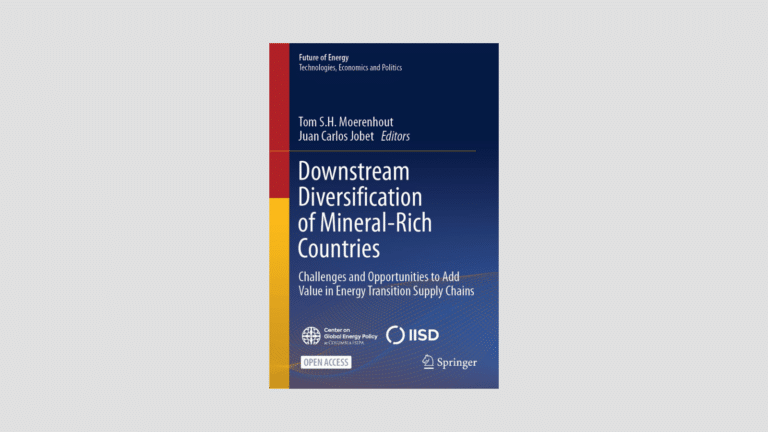
Downstream Diversification of Mineral-Rich Countries
This open access book sheds new light on the challenges and opportunities of downstream diversification in countries rich in critical minerals
The Energy Transition Won’t Work Without Coal Towns
A fossil fuel superpower cannot sustain deep emissions reductions if doing so drives up costs for vulnerable consumers.
The US Is Internationalizing Its Critical Minerals Industrial Policy
Securing critical minerals is a top priority of governments around the world.