Current Access Level “I” – ID Only: CUID holders, alumni, and approved guests only
Campus open to active affiliate Columbia University ID (CUID) holders and approved guests only.
Columbia students, faculty, and staff can use the guest registration portal to register up to two same-day guests. Alumni can use the portal to register for campus same-day access as well. Learn more below.
This website uses cookies as well as similar tools and technologies to understand visitors’ experiences. By continuing to use this website, you consent to Columbia University’s usage of cookies and similar technologies, in accordance with the Columbia University Website Cookie Notice.
The United States is at a rare inflection point for nuclear energy, with unprecedented momentum behind deployment and regulatory reform as nuclear becomes central to energy security, AI competitiveness, and state and corporate climate goals.
The Trump administration has prioritized nuclear energy expansion, aiming to increase US nuclear capacity fourfold by 2050. This nuclear energy resurgence in the US is a rare issue...
This workshop will be conducted in two parts: Part one on February 16 from 1:00 PM to 2:00 PM EST, and Part two on February 18 from 1:00 PM to...
Event
• Center on Global Energy Policy
1255 Amsterdam Ave, New York, NY 10027
About Us
We are the premier hub and policy institution for global energy thought leadership. Energy impacts every element of our lives, and our trusted fact-based research informs the decisions that affect all of us.
This Energy Explained post represents the research and views of the author(s). It does not necessarily represent the views of the Center on Global Energy Policy. The piece may be subject to further revision.
Contributions to SIPA for the benefit of CGEP are general use gifts, which gives the Center discretion in how it allocates these funds. More information is available here. Rare cases of sponsored projects are clearly indicated.
The Center on Global Energy Policy at Columbia University SIPA is closely following recent US actions in Venezuela and their impact on geopolitics, policy, and global energy markets. See all of our coverage here.
Venezuela holds 70% of Latin America’s natural gas reserves, which it could export to Colombia and Trinidad to increase revenues.
Two potential projects could make Venezuelan natural gas exports a reality: restarting and expanding an existing pipeline to connect Cardon IV’s Venezuelan field with Colombia, and a new pipeline connecting Venezuela’s offshore Dragon field with Trinidad’s LNG infrastructure.
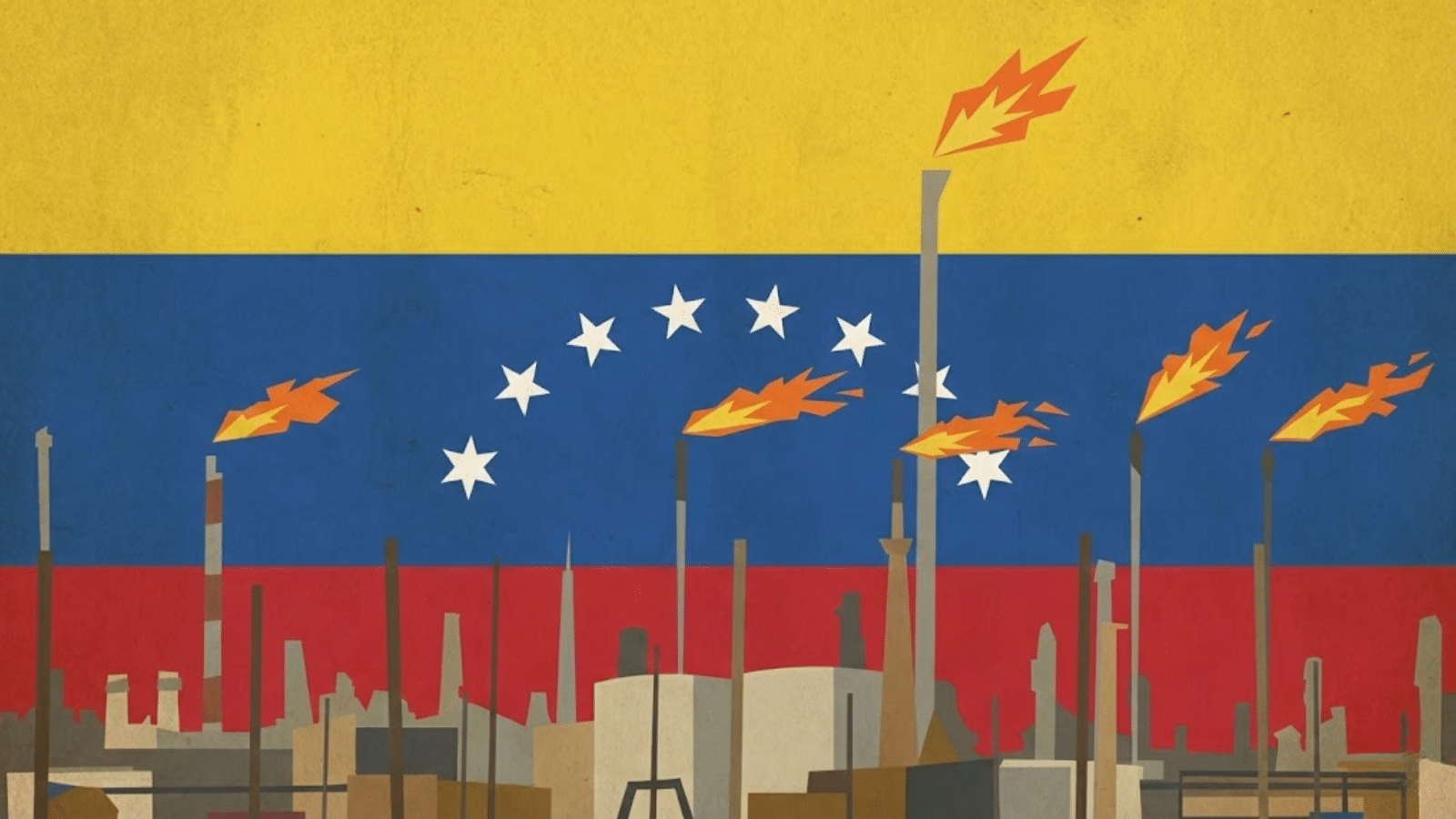
Recovering the 40% of Venezuela’s natural gas production that is currently flared or vented for domestic use, particularly in the electricity sector, will also be central to Venezuela’s economic recovery.
Oil has been at the forefront of US-Venezuela relations since the removal of former President Nicolás Maduro by US forces. However, discussions about Venezuela’s natural gas could become more relevant. Efficient use of Venezuela’s natural gas will be key to the recovery of the electricity sector, an objective stated by the US government as central to increasing oil production as well as to improving the country’s economic prospects.
But Venezuela’s potential to export natural gas to its Latin American neighbors could also feature in discussions between the US and other countries in the region, starting with Colombia’s President Gustavo Petro’s visit to the White House, scheduled for February. Venezuela could export its vast natural gas resources to Colombia and Trinidad, which would be strategically beneficial for both countries and would help Venezuela increase its export revenues.
In this Q&A, CGEP Adjunct Senior Research Scholar Dr. Luisa Palacios, with contributions from Diego Rivera Rivota and Ira Joseph, explore Venezuela’s natural gas export potential in the context of Latin America’s growing natural gas deficit, Colombia’s and Trinidad’s energy security, and Venezuela’s urgent need to restore reliability in its electricity system.
What is the current natural gas balance in the Latin American region, and why does Venezuela’s natural gas matter?
The natural gas reserves of Latin America and the Caribbean (LAC) account for just over 4% of the world’s total. However, these reserves are highly concentrated in a single country, Venezuela, which holds about 70% of the region’s total reserves. Venezuela, however, has failed to capitalize on its natural gas potential. Instead, the largest natural gas exporter in LAC is Trinidad and Tobago (Trinidad), whose liquefied natural gas (LNG) sales accounted for 50% of the region’s total pipeline and LNG exports, as of 2024, with Bolivia and Peru the other relevant exporters.
Despite the presence of regional natural gas exporters, LAC’s natural gas trade balance has been deteriorating in recent years. On the export side, Bolivia has experienced a decline in pipeline exports due to the government’s nationalist stance and rising domestic consumption. In Trinidad, falling production due to dwindling reserves has led to a 40% decline in LNG exports since the Covid-19 pandemic. While Argentina remains a net gas importer, this may change; it is expected to increase pipeline exports (to Brazil and Uruguay) and potentially LNG exports within the next decade. This might be insufficient, however, to reverse the region’s natural gas trade imbalance.
Nine countries in LAC were importers of LNG in 2025, with Brazil and Chile leading the pack, and Colombia growing the fastest. LNG imports have become a central component of the region’s energy security, mitigating the unpredictability of hydropower generation during droughts associated with weather events such as El Niño and La Niña.
Also, the region is expected to see 40% growth in natural gas demand over the next decade and Venezuela could be key to filling the region’s growing natural gas deficit if it manages to develop its natural gas potential.
How could Venezuela develop its natural gas exports?
Given a legal framework in Venezuela that allows 100% private-sector participation in non-associated natural gas (that which is not produced alongside crude oil), the country’s natural gas sector already includes international companies that can help it capitalize on its vast resources. Making Venezuela’s natural gas exports a reality would require some infrastructure investments.
Colombia and Venezuela have a 224 kilometer (139 mile) gas pipeline—the Trans-Caribbean pipeline—connecting the two countries. Built in 2007, the pipeline carried Colombian natural gas exports to Venezuela from 2009 through 2015, with the expectation that the trade flow would reverse thereafter, which it never did. To make Venezuelan exports to Colombia a reality, maintenance, repair, and expansion of the existing infrastructure to connect Cardon IV, an offshore natural gas field operated by ENI and Repsol in Western Venezuela, to the existing pipeline would be required.
Cardon IV, with reserves of 7 to 8 trillion cubic feet (tcf), currently produces about 0.5 billion cubic feet per day (bcf/d) of natural gas, with a maximum capacity estimated at 1.2 bcf/d. Such an increase in production could facilitate 0.5 bcf/d of exports to Colombia, potentially resulting in $700 to $800 million in export revenues per year for Venezuela, assuming Henry Hub prices (North America’s benchmark).
Such exports will significantly enhance Colombia’s energy security, given the country’s decline in natural gas production by about 20% since 2019 amid strong demand, mostly driven by its power sector.
What about the outlook for Venezuela’s exports to Trinidad and Tobago?
Trinidad has 11.4 million tons per annum (mtpa) of LNG capacity. While this is equivalent to 2.1 bcf/d, the country’s LNG exports are currently 1 bcf/d. For adecade, Trinidad has been seeking to finalize an agreement to import Venezuela’s offshore gas through Trinidad’s gas infrastructure. The most concrete of these projects is the 16 kilometer (10 mile) pipeline connecting the Shell-operated Dragon Field on the Venezuelan side with the company’s nearby Hibiscus offshore platform in Trinidad, connected to Trinidad’s LNG infrastructure (Shell has the majority equity ownership of Trinidad’s Atlantic LNG project’s four trains). A 30-year agreement between Trinidad and Venezuela was finally reached in 2023, only to see geopolitical risks postpone the project.
Dragon field, which holds an estimated 4 tcf of reserves, could potentially boost Trinidad’s LNG exports by 35%, taking into account Shell’s existing plans of an initial phase of production of 0.2 bcf/d ramping up to 0.35 bcf/d. Such natural gas exports to Trinidad could conservatively represent about $500 million in revenues for Venezuela.[1]
Other projects could also be developed, such as the Cocuina-Manakin field (Bloc 4 of Venezuela’s Plataforma Deltana offshore natural gas area), in which Venezuela granted in 2024 a 20-year license to Trinidad’s national gas company, NGC, and bp for the joint development of the cross-border field.
Would these export projects compete with Venezuela’s own domestic natural gas needs?
Developing Venezuela’s natural gas export potential should not come at the expense of domestic consumption.Most of Venezuela’s natural gas production is associated with its oil production, which, given the oil sector’s steep decline in the last decade, explains the 60% decline in natural gas output since 2015.
Also, a large amount of this associated gas is currently being wasted or underutilized. More than 40% of the country’s 3 bcf/d production is estimated to be either vented or flared by the national oil company PDVSA. This wasted gas is equivalent to Colombia’s annual gas consumption, ranking Venezuela among the largest methane emitters and flaring countries globally, and representing an annual opportunity cost of about $1 billion in natural gas revenues.[2] The dramatic loss of PDVSA’s operational, financial, and technical capacity over the past decades, as well as the expropriation of the country’s oil suppliers, such as Williams, that took place in the 2000s, led to a significant decline in the country’s ability to recover this gas.
Increasing the country’s utilization of its associated natural gas production will be central to Venezuela’s oil industry but also to restore the reliability of its power system. On the latter, changes to the electricity law have been among the first economic measures enacted by Delcy Rodríguez, Venezuela’s interim president.
Most of Venezuela’s electricity comes from its mega hydroelectric plant, Guri. However, mismanagement, corruption, lack of technical capacity, expropriations, and droughts have led to unreliability of the system, causing frequent blackouts, particularly outside the capital, Caracas. The lack of access to reliable electricity has been one of the main economic drivers of Venezuelan emigration.
Almost 20% of Venezuela’s electric generation capacity is thermal, but it is operating at 15% capacity. Providing an outlet for Venezuela’s unutilized associated natural gas and restoring the country’s thermal generation capacity will be key to enhancing the reliability of the country’s electricity system. Such efforts will be central to the country’s economic recovery.
[1] Assuming 2025 average annual price for Henry Hub.
[2] According to the World Bank, Venezuela flared a total of 8.3 billion cubic meters in 2024 (which translates into 0.8 bcf/d). In addition, the IEA’s methane tracker estimates methane emissions from Venezuela of 3,580.5 kilotons (0.5 bcf/d) in 2024, which result in a combined natural gas loss equivalent of about 1.3 bcf/d. This wasted gas represents more than 40% of the country’s natural gas production of about 3.1 bcf/d.
China’s crude oil imports hit a record-high 11.6 million barrels per day in 2025, as geopolitical tensions, low oil prices, and global oversupply spurred China to increase its oil stockpiles, a trend likely to continue in 2026.
The US intervention in Venezuela may jeopardize both the flow of discounted Venezuelan oil to China's teapot refineries and the role of Chinese oil companies in Venezuela’s upstream business.