The Next Big Energy Trade After Oil · Ira Joseph
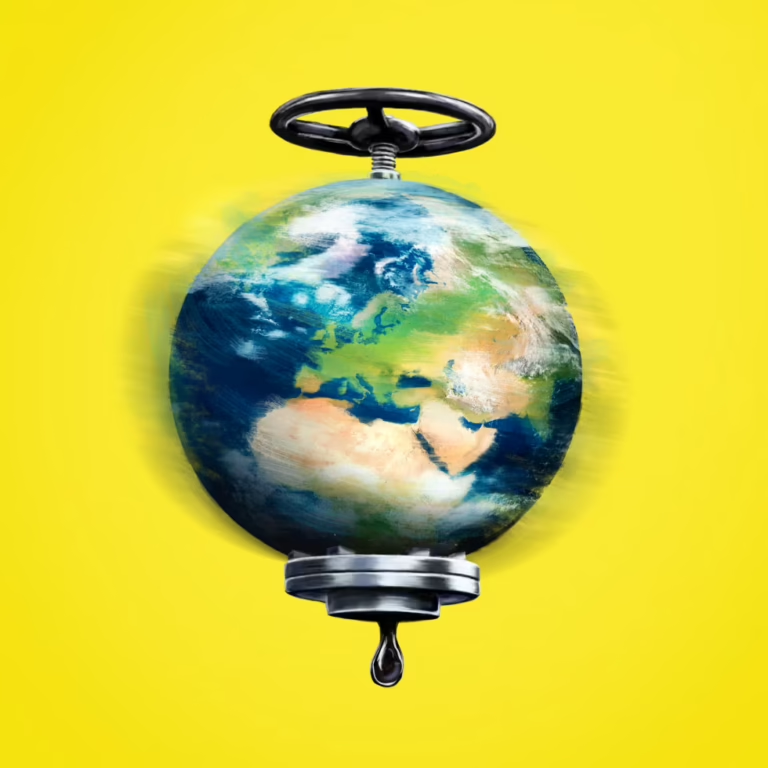
For most of its life, US natural gas was a purely domestic price. It answered American weather, American production, American supply. That is changing fast.T...
Get the latest as our experts share their insights on global energy policy.
The Iran crisis, whenever it ends, will materially change how the LNG market operates.
Hear in-depth conversations with the world’s top energy and climate leaders from government, business, academia, and civil society.
Nearly a month after a ceasefire, the US-Iran deal seems to have all but collapsed as both nations have slipped back into active conflict. On Sunday, Tehran announced...
Past Event
September 14, 2016
12:00 pm - 1:30 pm
The Center on Global Energy Policy hosted a presentation and panel discussion on the recently released report on Venezuela’s oil industry, which explores the increasing risks posed by the troubles in this OPEC member country’s oil sector and its unprecedented economic, social and political crisis. Author Luisa Palacios, Senior Managing Director and Head of Latin America Macro and Energy Research at Medley Global Advisors, and Fellow at the Center on Global Energy Policy, will present her report. Following the presentation, Christopher Sabatini, Lecturer of International Relations and Policy at the School of International and Public Affairs and Founder and Executive Director of research non-profit Global Americans, and Adrian Lajous, former CEO of PEMEX and Center Fellow, will join the panel discussion which will be moderated by Antoine Halff, Center Program Director – Global Oil Markets.
On February 28, the United States and Israel launched an attack on Iran, resulting in the deaths of Iranian Supreme Leader Ali Hosseini Khamenei and senior Iranian leaders...


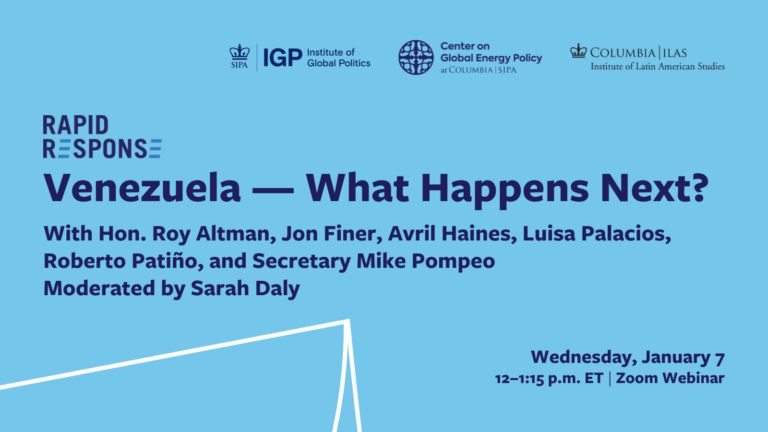
The recent military operation to remove Venezuelan President Nicolás Maduro and First Lady Cilia Flores raises several implications for the future of Venezuela and Latin America, geopolitics, and energy markets. Cosponsored by SIPA’s Institute of Global Politics (IGP) and Center for Global Energy Policy (CGEP), along with Columbia’s Institute of Latin American Studies (ILAS), this webinar will analyze the circumstances and impact of their capture and extradition to New York to face narcoterrorism and drug trafficking charges.
On October 22, the United States Department of the Treasury announced the imposition of sanctions on Russia’s two largest oil companies, Rosneft and Lukoil, as a penalty for what it characterized as a lack of Russian commitment to ending the war in Ukraine.
*Registration is closed for this event. The Center on Global Energy Policy at Columbia University SIPA's Women in Energy initiative, in collaboration with the Columbia Policy Institute, invites...