This website uses cookies as well as similar tools and technologies to understand visitors’ experiences. By continuing to use this website, you consent to Columbia University’s usage of cookies and similar technologies, in accordance with the Columbia University Website Cookie Notice.
Energy abundance means different things in today’s global context than it did even a decade ago. It is about expanding electricity access while meeting rising energy demand. It...
PCCMs facilitate the generation, trading, and retirement of carbon credits from projects that remove, reduce, or avoid greenhouse gas emissions. By creating a revenue stream from verified climate...
Event
About Us
We are the premier hub and policy institution for global energy thought leadership. Energy impacts every element of our lives, and our trusted fact-based research informs the decisions that affect all of us.
The Outlook for Offshore Energy Production in a Low Oil Price Environment
Past Event
November 2, 2017
5:30 pm - 7:00 pm
Share
Please join the Center on Global Energy Policy for a discussion on the outlook for offshore energy production in a low oil price environment. Jason Bordoff, CGEP Founding Director, will moderate the discussion and we are pleased to be joined by: – Lars Christian Bacher, Executive Vice President, Development & Production International, Statoil – Tommy Beaudreau, Partner, Environment, Land & Resources Department of Latham & Watkins and former Chief of Staff at the US Interior Department – Adrián Lajous, non-resident Fellow, Center on Global Energy Policy and former Director General of Pemex – Antoine Halff, Senior Research Scholar, Center on Global Energy Policy – Amy Jaffe, David M. Rubenstein Senior Fellow for Energy and the Environment at the Council on Foreign Relations Registration is required. Guests unable to attend can view a livestream of the event at energypolicy.columbia.edu/watch. A podcast of this event will be available ~7 days after the date of the event through iTunes and our website. This event is open to press. Please direct media inquiries to Jamie Shellenberger-Bessmann ([email protected])
On February 28, the United States and Israel launched an attack on Iran, resulting in the deaths of Iranian Supreme Leader Ali Hosseini Khamenei and senior Iranian leaders...
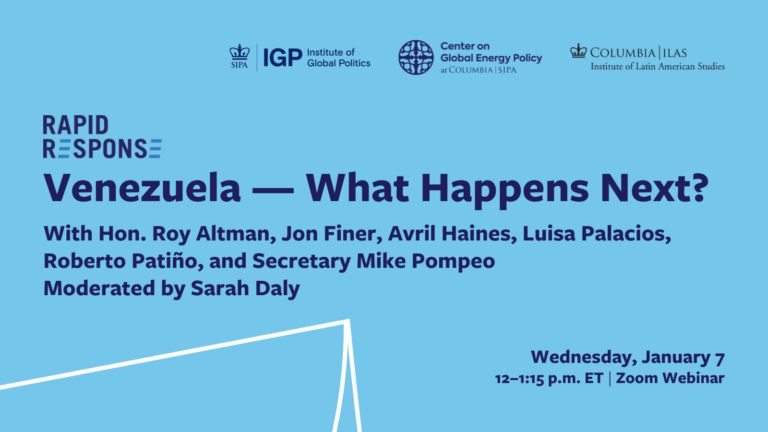
The recent military operation to remove Venezuelan President Nicolás Maduro and First Lady Cilia Flores raises several implications for the future of Venezuela and Latin America, geopolitics, and energy markets. Cosponsored by SIPA’s Institute of Global Politics (IGP) and Center for Global Energy Policy (CGEP), along with Columbia’s Institute of Latin American Studies (ILAS), this webinar will analyze the circumstances and impact of their capture and extradition to New York to face narcoterrorism and drug trafficking charges.
https://www.youtube.com/watch?v=vWh5WQVVMLc Global gas markets are set to undergo major changes by the end of the decade, with the coming wave of liquefied natural gas (LNG) production capacity poised...
On October 22, the United States Department of the Treasury announced the imposition of sanctions on Russia’s two largest oil companies, Rosneft and Lukoil, as a penalty for what it characterized as a lack of Russian commitment to ending the war in Ukraine.
The centre of gravity of the global energy system has definitively shifted eastward, driven by rapid industrialisation, expanding urban populations, and rising
CHRONIQUE. Les Etats-Unis vont bientôt contrôler environ un tiers des capacités mondiales de GNL, bien plus que le Qatar. Sous l’administration Trump, le GNL est devenu un outil de politique étrangère, écrit Anne-Sophie Corbeau, chercheuse au Center on Global Energy Policy de l’Université Columbia