This website uses cookies as well as similar tools and technologies to understand visitors’ experiences. By continuing to use this website, you consent to Columbia University’s usage of cookies and similar technologies, in accordance with the Columbia University Website Cookie Notice.
“The waived 100% tariff was actually a proposed penalty on US imports from major buyers of Russian oil and gas, not a tariff on the gas itself,” said Tatiana Mitrova, global fellow at Columbia University’s Centre on global energy policy. “Its suspension is theoretically bearish for energy prices, compared with
Reporting in the New York Times suggests a key element in the Trump administration's Russia-Ukraine peace plan involves Europe resuming Russian gas imports.
After years of trying, the US may be on the cusp of a nuclear renaissance. Commercial nuclear generation began in this country in 1958. Today, the US has...
Registration is closed. Join Women in Energy and Pillsbury in Washington, D.C., for a conversation examining the key trends and developments shaping the energy industry, where opportunities are...
Event
• Pillsbury
1200 Seventeenth Street NW, Washington, DC 20036
About Us
We are the premier hub and policy institution for global energy thought leadership. Energy impacts every element of our lives, and our trusted fact-based research informs the decisions that affect all of us.
National oil companies from emerging markets produce about 50 percent of the world’s oil, hold about 50 percent of global refining capacity, and own most of the world’s oil and gas reserves. With oil prices at more than $80/barrel, they are also generating significant oil revenues. With COP28 taking place in the United Arab Emirates, a major oil exporting country with a strong national oil company, the role of oil and gas in the energy transition, and that of national oil companies, is going to take center stage in the discussions in Dubai.
What are these companies’ decarbonization goals? What kind of investments are they making in clean energy technologies, if any? Join the Center on Global Energy Policy (CGEP) at Columbia University’s School of International and Public Affairs (SIPA) as we discuss the policy and investment choices of national oil companies in the energy transition.
Moderator:
Patrick Heller, Chief Program Officer, Natural Resources Governance Institute
Speakers:
Erica Downs, Senior Research Scholar, Center on Global Energy Policy at Columbia SIPA
Tatiana Mitrova,Research Fellow, Center on Global Energy Policy at Columbia SIPA
Luisa Palacios, Senior Research Scholar, Center on Global Energy Policy at Columbia SIPA
Karen E. Young, Senior Research Scholar, Center on Global Energy Policy at Columbia SIPA
—
This event will be hosted in person in New York City and live-streamed via Zoom.
Advance registration is required. Upon registration, you will receive a confirmation email. The event will be recorded and the video recording will be added to our website following the event.
This event is open to the press, and registration is required to attend. For media inquiries or requests for interviews, please contact Natalie Volk ([email protected]). For more information about the event, please contact [email protected].
On February 28, the United States and Israel launched an attack on Iran, resulting in the deaths of Iranian Supreme Leader Ali Hosseini Khamenei and senior Iranian leaders...
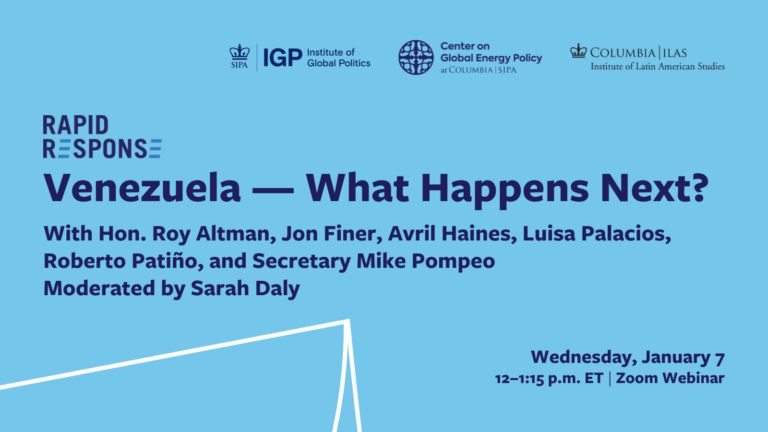
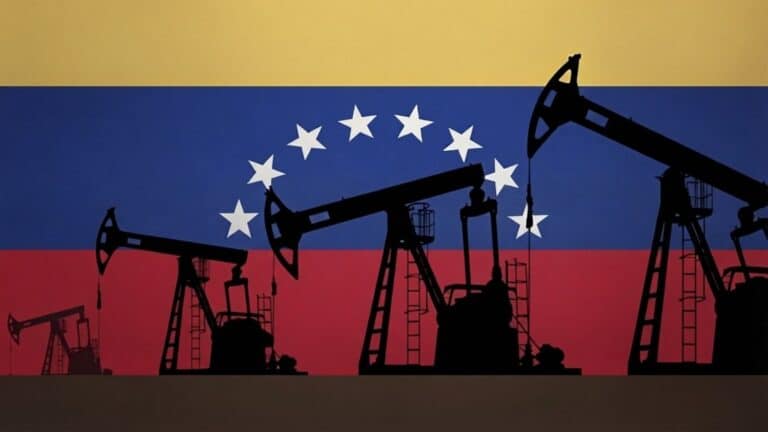
The recent military operation to remove Venezuelan President Nicolás Maduro and First Lady Cilia Flores raises several implications for the future of Venezuela and Latin America, geopolitics, and energy markets. Cosponsored by SIPA’s Institute of Global Politics (IGP) and Center for Global Energy Policy (CGEP), along with Columbia’s Institute of Latin American Studies (ILAS), this webinar will analyze the circumstances and impact of their capture and extradition to New York to face narcoterrorism and drug trafficking charges.
On October 22, the United States Department of the Treasury announced the imposition of sanctions on Russia’s two largest oil companies, Rosneft and Lukoil, as a penalty for what it characterized as a lack of Russian commitment to ending the war in Ukraine.
*Registration is closed for this event. The Center on Global Energy Policy at Columbia University SIPA's Women in Energy initiative, in collaboration with the Columbia Policy Institute, invites...
Event
• International Affairs Building,
Columbia SIPA
The White House announced last week an oil deal for more than 65 billion barrels of oil reserves in Venezuela and a 35% equity stake in North American Blue Energy Partners (NABEP).