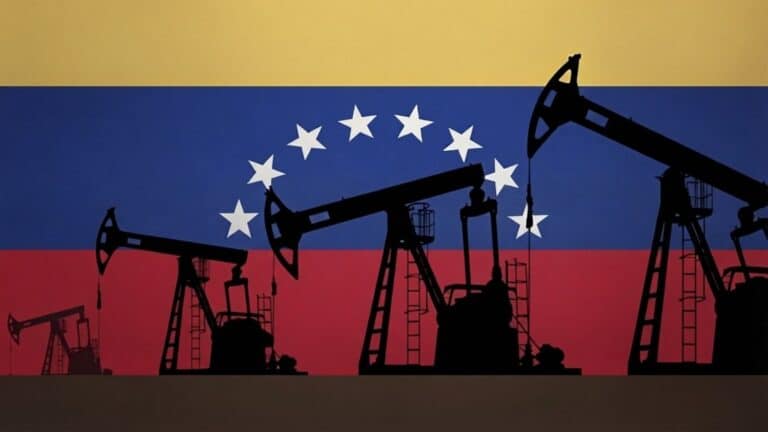
Trump Turns to Socialist Venezuela As Gas Prices Bite Ahead of Midterms
Trump welcomes 1 million barrels of Venezuelan oil as high gas prices remain a concern for voters ahead of the midterms.
Get the latest as our experts share their insights on global energy policy.
This Energy Explained post represents the research and views of the author(s). It does not necessarily represent the views of the Center on Global Energy Policy. The piece...

Hear in-depth conversations with the world’s top energy and climate leaders from government, business, academia, and civil society.
Every permitting bill promises the same thing: build faster. The harder question is what the trade-offs are, and who bears them. That question is at the heart of...

Find out more about our upcoming and past events.
The Center on Global Energy Policy (CGEP) at Columbia University’s School of International and Public Affairs and ReNew invite you to Columbia India Energy Dialogue 2026, taking place...

Past Event
May 22, 2018
9:30 am - 11:00 am
LOCATION: Princeton Club of NY 15 West 43rd St. New York, NY 10036 Join the Center on Global Energy Policy for a presentation and discussion of the IEA’s report “Oil 2018 – Analysis and Forecasts to 2023” with Neil Atkinson, IEA’s Head of the Oil Industry & Markets Division. Oil 2018 is the IEA’s annual five-year forecast of global oil demand, supply refining, and trade. Global oil demand growth remains healthy driven by developing countries in Asia, even as oil consumption growth slows down in China thanks to new environmental policies designed to curb air pollution. Strong growth in petrochemicals demand globally is another key area of growth. Upstream investments have not rebounded from the historic two-year decline seen in 2015-2016 except in the United States which dominates the supply growth story. Meanwhile, there is uncertainty over the longer-term prospects of the successful OPEC and non-OPEC market management policy. These strands set the scene for Oil 2018’s analysis of the market, which examines a wide range of other important issues and uncertainties, including: • The implications for oil demand of the 2020 IMO marine fuel regulations. • The growth of the global petrochemicals sector. • The rise of electrification in China’s transport fleet. • Decline rates in key oil producing countries. • Crude quality issues arising from the rapid increase in US production. • Investment needs in North American takeaway capacity. • Implications for global refining of the looming capacity surplus. • Trends in global oil trade. CGEP Founding Director, Jason Bordoff will moderate the discussion following Mr. Atkinson’s presentation. Registration is required. Guests unable to attend can view a livestream of the event at http://energypolicy.columbia.edu/livestream. A podcast of this event will be available ~12 days after the date of the event through iTunes and our website. This event is open to press. Please direct media inquiries to Jesse McCormick ([email protected]) For more information contact: [email protected]
On February 28, the United States and Israel launched an attack on Iran, resulting in the deaths of Iranian Supreme Leader Ali Hosseini Khamenei and senior Iranian leaders...


Join us for an in-person event exploring careers and opportunities in the rapidly evolving electric vehicle and sustainable transportation ecosystem.
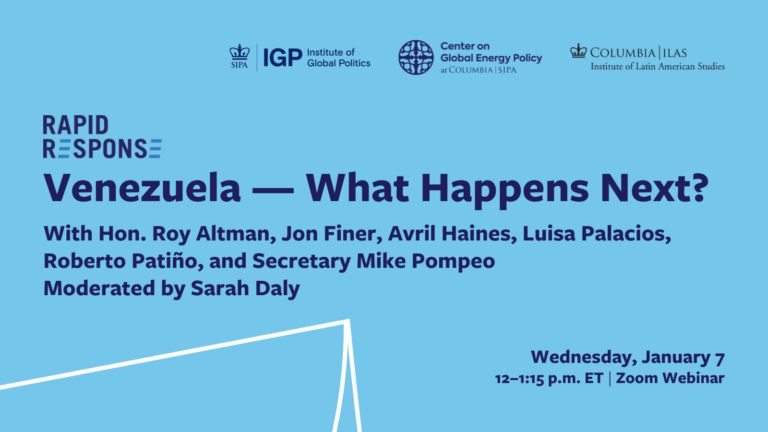
The recent military operation to remove Venezuelan President Nicolás Maduro and First Lady Cilia Flores raises several implications for the future of Venezuela and Latin America, geopolitics, and energy markets. Cosponsored by SIPA’s Institute of Global Politics (IGP) and Center for Global Energy Policy (CGEP), along with Columbia’s Institute of Latin American Studies (ILAS), this webinar will analyze the circumstances and impact of their capture and extradition to New York to face narcoterrorism and drug trafficking charges.
On October 22, the United States Department of the Treasury announced the imposition of sanctions on Russia’s two largest oil companies, Rosneft and Lukoil, as a penalty for what it characterized as a lack of Russian commitment to ending the war in Ukraine.

The White House announced last week an oil deal for more than 65 billion barrels of oil reserves in Venezuela and a 35% equity stake in North American Blue Energy Partners (NABEP).