This website uses cookies as well as similar tools and technologies to understand visitors’ experiences. By continuing to use this website, you consent to Columbia University’s usage of cookies and similar technologies, in accordance with the Columbia University Website Cookie Notice.
Nearly a month after a ceasefire, the US-Iran deal seems to have all but collapsed as both nations have slipped back into active conflict. On Sunday, Tehran announced...
We are the premier hub and policy institution for global energy thought leadership. Energy impacts every element of our lives, and our trusted fact-based research informs the decisions that affect all of us.
2nd Roundtable on the Resilience of the Liquid Fuel Supply Chain in the Tri-State Area
Past Event
October 17, 2014 - July 15, 2026
5:00 am
Share
The Center on Global Energy Policy (CGEP) hosted our second off-the-record roundtable on the resilience of the liquid fuel supply chain in the New York Tri-state area. The event took place Friday, October 17, 2014, from 9am to 3pm in New York City at Columbia University.
The October 17th meeting was part of a planned series of convenings among senior-level stakeholders that began on May 9, 2014 at the request of the City of New York, and part of a larger CGEP program to monitor energy sector resilience. The prime purpose of the meetings is to facilitate regional cooperation to maximize resilience of the Tri-state area’s liquid fuel supply chain.
This roundtable is open only to currently enrolled Columbia University students. To register, you must sign in with your UNI. The Center on Global Energy Policy (CGEP) at...
Event
• Center on Global Energy Policy
1255 Amsterdam Ave, New York, NY 10027
On February 28, the United States and Israel launched an attack on Iran, resulting in the deaths of Iranian Supreme Leader Ali Hosseini Khamenei and senior Iranian leaders...
The Center on Global Energy Policy (CGEP) at Columbia SIPA and the Fashion, Energy, and Climate Network invite you to join the first session of our new talk...
Event
• Center on Global Energy Policy
1255 Amsterdam Ave, New York, NY 10027
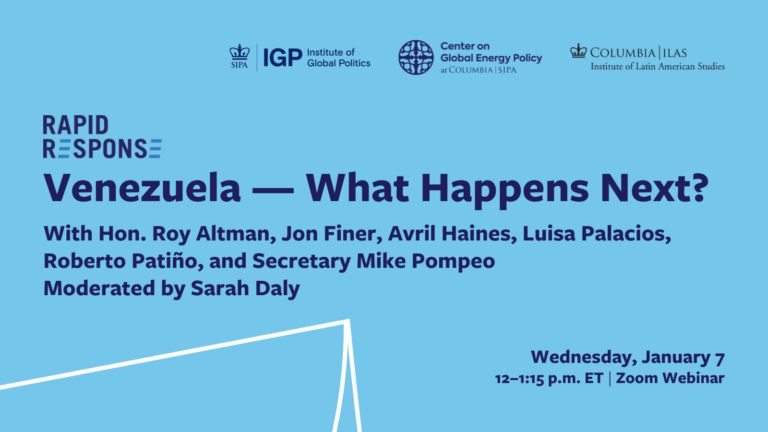
The recent military operation to remove Venezuelan President Nicolás Maduro and First Lady Cilia Flores raises several implications for the future of Venezuela and Latin America, geopolitics, and energy markets. Cosponsored by SIPA’s Institute of Global Politics (IGP) and Center for Global Energy Policy (CGEP), along with Columbia’s Institute of Latin American Studies (ILAS), this webinar will analyze the circumstances and impact of their capture and extradition to New York to face narcoterrorism and drug trafficking charges.