This website uses cookies as well as similar tools and technologies to understand visitors’ experiences. By continuing to use this website, you consent to Columbia University’s usage of cookies and similar technologies, in accordance with the Columbia University Website Cookie Notice.
The Center on Global Energy Policy (CGEP) at Columbia University SIPA today announced new personnel additions who bring extensive experience from government and the private sector to the...
Announcement• July 3, 2025
Energy Explained
Get the latest as our experts share their insights on global energy policy.
The European Commission (EC) published a proposed regulation on June 17 to end Russian gas imports by the end of 2027; this followed the initial roadmap to do...
The global energy landscape is shifting right now. Geopolitical tensions in the Middle East, debates about peak oil demand, and waning support for climate action in some parts...
This year, the Third Annual Energy Opportunity Lab (EOL) Forum will take place July 7th and 8th in Washington, DC, offering a chance for the Washington policymaking community...
Event
About Us
We are the premier hub and policy institution for global energy thought leadership. Energy impacts every element of our lives, and our trusted fact-based research informs the decisions that affect all of us.
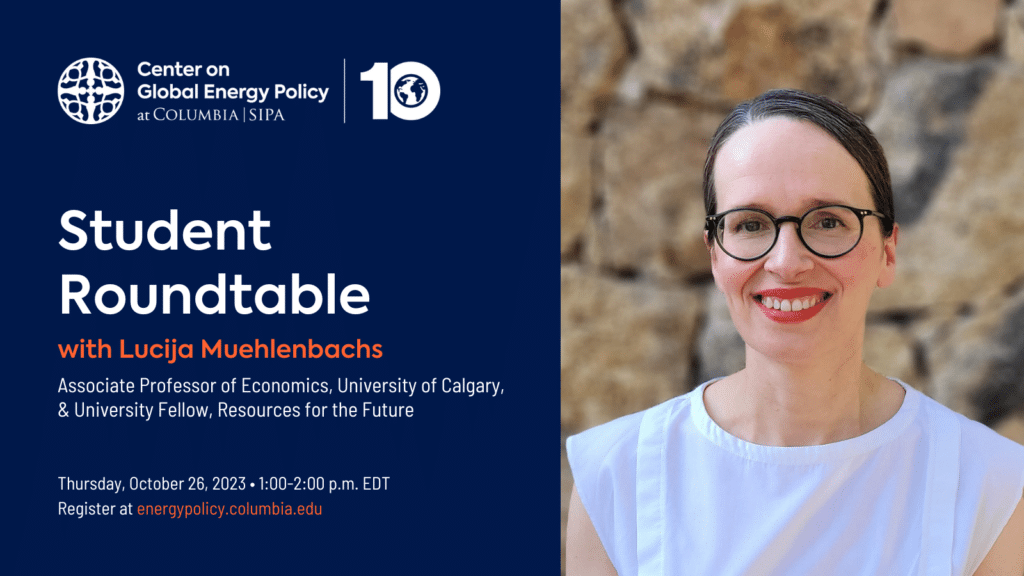
(Cancelled) Student Roundtable and Lunch with Professor Lucija Muehlenbachs
Past Event
October 26, 2023
1:00 pm - 2:00 pm edt
Share
This roundtable is open only to currently-enrolled Columbia University students.
Please join the Center on Global Energy Policy at Columbia SIPA for a student-only lunch and roundtable discussion with Professor Lucija Muehlenbachs, visiting faculty member at the Center on Global Energy Policy at Columbia SIPA; associate professor of economics at the University of Calgary, and a university fellow at Resources for the Future.
Muehlenbachs will present her current research showing evidence of oil being drained away from First Nations reserves in Canada, with a discussion of the implications for equity and government oversight. Following introductions, we will move into an open conversation.
Lunch will be provided.
Biography
Lucija Muehlenbachs is an associate professor of economics at the University of Calgary and a university fellow at Resources for the Future. She has published extensively on the oil and gas industry, on topics such as end-of-life liabilities, environmental enforcement, implications on housing prices, water quality, waste management, and truck traffic. Achievements include providing analysis for the National Commission on the BP Deepwater Horizon Oil Spill and Offshore Drilling and serving on the editorial boards of five journals.
—
Registration is required. This roundtable is open only to currently-enrolled Columbia University students. To register, you must sign in with your UNI.
This event will be hosted in person and capacity is limited. We ask that you register only if you can attend this event in its entirety. For more information about the event, please contact [email protected].
Energy finance is transforming rapidly amid shifting political and economic dynamics in the U.S. and globally. As the landscape becomes increasingly complex, we will explore key legal insights,...
Event
• Pillsbury Winthrop Shaw Pittman
31 West 52nd Street
New York, NY 10019, USA
Chokepoints tells the epic story of how America turned the world economy into a weapon, upending decades of globalization to confront a new authoritarian axis—Russia, China, and Iran. In...
Event
• The Foyer, 2nd Floor
The Forum at Columbia University
The Columbia Global Energy Summit 2024 is an annual event dedicated to thought-provoking discussions around the critical energy and climate challenges facing the global community.
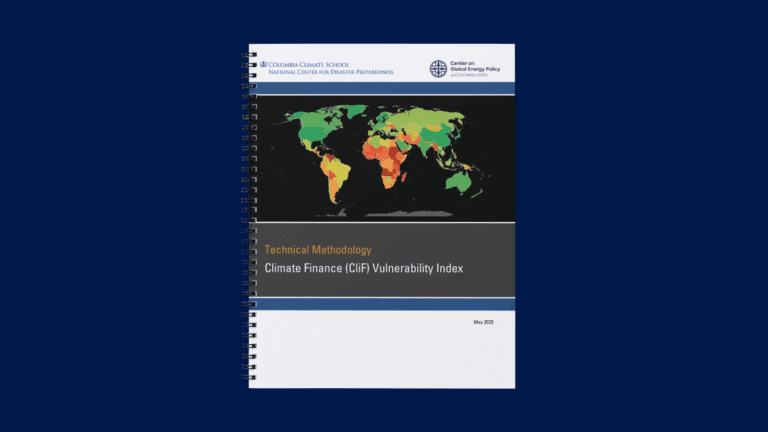
The Climate Finance (CliF) Vulnerability Index is designed to provide a comprehensive understanding of climate vulnerability for nation states in order to improve the targeting and provision of climate change adaptation financing.