This website uses cookies as well as similar tools and technologies to understand visitors’ experiences. By continuing to use this website, you consent to Columbia University’s usage of cookies and similar technologies, in accordance with the Columbia University Website Cookie Notice.
Energy Explained
Get the latest as our experts share their insights on global energy policy.
Disruptions in the Middle East Reinforce China’s Aim for Greater Self-Sufficiency in Refining and Petrochemicals
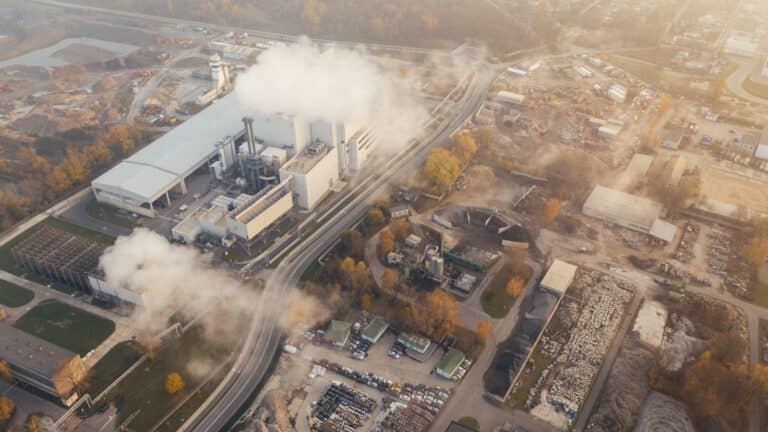
Many analyses of what the conflict in the Middle East means for China's energy security have rightly focused on China's oil and natural gas imports from the region.
Podcasts
Hear in-depth conversations with the world’s top energy and climate leaders from government, business, academia, and civil society.
Speed to Power: Christian Bruch on Siemens Energy’s Turnaround
For years, the energy transition was discussed as a shift that would happen in steady, predictable increments. But the last 24 months have shattered that illusion. Energy providers...

News
The Center on Global Energy Policy Announces New Distinguished Visiting Fellows from US, European, and Indian Governments and Civil Society
October 17, 2025
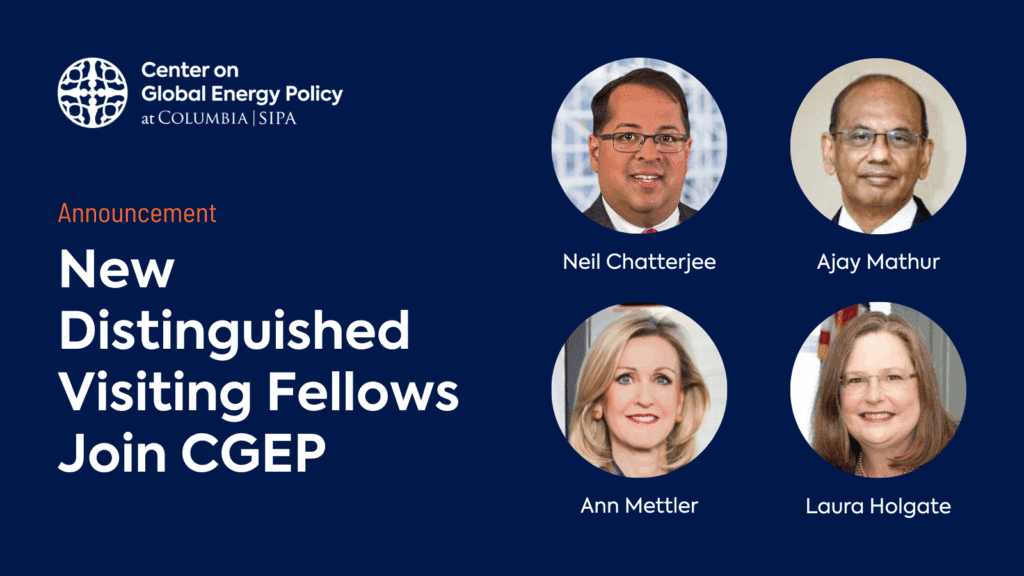
The Center on Global Energy Policy (CGEP) at Columbia University SIPA today welcomed four new distinguished visiting fellows who will add extensive energy and geopolitical expertise from the United States, European, and Indian governments and civil society to CGEP’s roster of experts and policymakers. The fellows will conduct and contribute to CGEP research and publications, participate in public CGEP convenings and events, and engage with students and faculty throughout the Columbia Community.
“The Center on Global Energy Policy’s Distinguished Visiting Fellows program brings leading experts from government service directly to our intellectual community, allowing them to contribute timely perspectives on key issues to policy conversations surrounding energy security, energy markets, and the global energy transition,” said Jason Bordoff, CGEP Founding Director. “This remarkable new cohort of fellows brings a range of experience from the highest levels of government and civil society to CGEP, bolstering our leadership and insights on pressing topics such as the power sector, nuclear security and nonproliferation, energy security and resilience, and renewable energy, and on regions from Europe to South Asia.”
CGEP’s new distinguished visiting fellows can be found below:
Neil Chatterjee
Neil Chatterjee, Former Commissioner and Chairman, Federal Energy Regulatory Commission (FERC), joined Palmetto in early 2025 as the Chief Government Affairs Officer. Neil is a policy reformer with extensive experience across the energy landscape both domestically and internationally. He built a reputation as a bipartisan operator who builds alliances and cuts through red tape with an eye on promoting innovation, and is an advocate for harnessing technology to mitigate threats to critical energy infrastructure.
Neil Chatterjee said, “I am glad to join the Center on Global Energy Policy and the Columbia University community as a distinguished visiting fellow. There’s a pressing need for solutions to America’s most intractable energy problems, from permitting reform to increasing electricity demand. I look forward to productive conversations with students and faculty to engage policymakers in pursuit of those aims.”
Ajay Mathur
Dr. Ajay Mathur is a Professor of Practice in the School of Public Policy at IIT, Delhi. He was previously the Director General of the International Solar Alliance (ISA) (2021-2025), The Energy and Resources Institute (TERI) (2016-2021), and the Bureau of Energy Efficiency (BEE) (2006-2012 and 2013-2016). He has also served as a member of the Prime Minister of India’s Council on Climate Change and co-chair of the global Energy Transitions Commission and the Clean Cooling Initiatives of the One Planet Summit. He was a leading Indian and G-77 climate change negotiator (2006-2012) and was the Indian spokesperson at the Paris climate negotiations (2015). Dr Mathur received his Bachelor’s degree in Chemical Engineering from the (then) University of Roorkee and Masters and PhD degrees from the University of Illinois. He has also received the Distinguished Alumnus Awards from both his alma maters.
Ajay Mathur said, “The international community must make progress on a slate of critical issues during COP and other climate negotiations each year, and the Center on Global Energy Policy is well-positioned to further the policy discussions that can move those ambitions from theory to practice. I am pleased to join CGEP as a distinguished visiting fellow and look forward to engaging with the Columbia community on mitigating the effects of climate change and furthering the energy transition.”
Ann Mettler
Ann Mettler is currently leading the establishment of a new organization focused on advancing energy resilience and clean tech innovation. This initiative builds on the Energy Resilience Leadership Group, which she co-founded in 2023 with the CEO of Siemens Energy, in the wake of the Ukraine war. From 2020 to 2025, she served as Vice President for Europe at Breakthrough Energy, an organization founded by Bill Gates. Prior to that, from 2014 to 2019, Ann was Director-General and Head of the European Political Strategy Centre (EPSC), the European Commission’s in-house think tank reporting directly to the President. Ann holds Master’s degrees in Political Science and European Law & Economics, graduating with distinction from the University of New Mexico (USA) and Rheinische Friedrich-Wilhelms-University in Bonn (Germany).
Ann Mettler said, “We need innovative policies, next-generation technologies, and systems thinking to meet the unprecedented demands of the energy transition. I am pleased to join the Center to help develop solutions fit for a new geopolitical era. I look forward to engaging with students, faculty, and policymakers on both sides of the Atlantic—and around the world.”
Laura Holgate
Laura S. H. Holgate, Ambassador (ret.), is President of LSHH International Advisors. She served twice as a US ambassador to the International Atomic Energy Agency and other international organizations in Vienna, Austria. Amb. Holgate has held multiple positions in and out of government, including Vice President at the Nuclear Threat Initiative, Special Assistant to the President at the National Security Council, and a senior official at the Departments of Energy and Defense. She is a life member of the Council on Foreign Relations, past president and member of Women in International Security, a member of the World Institute of Nuclear Security, and serves on multiple advisory panels.
Laura Holgate said, “The pursuit of advanced nuclear energy technologies demands a robust community of policymakers who are committed to new approaches and innovative solutions. I am pleased to be appointed a distinguished visiting fellow at the Center on Global Energy Policy as we work to pursue the next generation of policies that will accelerate the deployment of firm, clean, and safe nuclear energy in ways that enhance national security.”
The distinguished visiting fellows program brings world-renowned scholars and former government officials into CGEP’s orbit for what is typically a 12-month period. Distinguished visiting fellows participate in a variety of activities–including events and engagements with Columbia University students, faculty, and staff–contribute to CGEP publications, and help CGEP engage policymakers in Washington, DC and around the world. More information about the program is available here.
Related
More News
Is an energy crisis coming for the global economy?
Europe and Asia are facing fuel shortages. The U.S. is in a fuel deficit. Some experts say the Iran War has caused the largest energy security threat in history. And it's about to get worse.
CCS Faces Fresh Challenges Amid War-Driven Energy Crisis
The face of carbon removal is changing from large-scale megaprojects to more focused and modular approaches as prices rise and priorities shift.
Relevant
Publications
Disruptions in the Middle East Reinforce China’s Aim for Greater Self-Sufficiency in Refining and Petrochemicals
Many analyses of what the conflict in the Middle East means for China's energy security have rightly focused on China's oil and natural gas imports from the region.