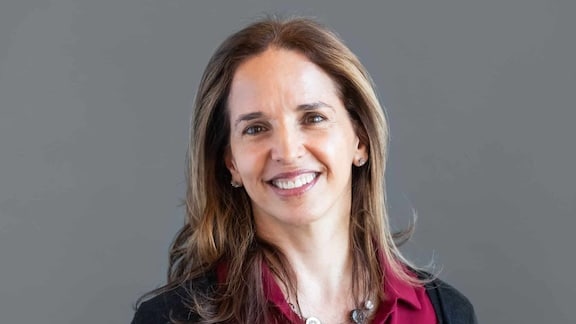
Maureen E. Raymo is Co-Founding Dean of the Columbia Climate School, Director of the Lamont-Doherty Earth Observatory, and G. Unger Vetlesen Professor of Earth & Environmental Sciences.
She has degrees from Brown and Columbia Universities and studies the history and causes of climate change in Earth’s past. She is best known for the Uplift-Weathering Hypothesis that ties global cooling and the onset of the ice ages to a drawdown in atmospheric CO2 caused by the uplift of the Himalayas and Tibetan Plateau.
In addition to publishing fundamental work on the stratigraphy and chronology of the recent geologic epochs, Raymo has also proposed hypotheses explaining the patterns of ice sheet variability observed over the last few million years and developed new ways of studying past sea level change. In 2014 she was the first woman to be awarded the Wollaston Medal by the Geological Society of London, their most prestigious award given out annually since 1831.
Raymo’s research has always focused on documenting how and discovering why the Earth’s oceans, biogeochemical cycles, and climate have changed in the past, knowledge that is integrated with numerical models of past and future climate. Through detailed analysis of deep sea sediment cores, she has generated records of geochemical, paleontological, and paleoclimatic change that have advanced the study of Earth’s climate on tectonic, orbital, and millennial time scales.
For much of her career she has also worked to improve the timescales and stratigraphy that provide the foundation for the study of Earth’s history. Most recently her research group has focused on the reconstruction of sea level and ice volume during past warm climate intervals with the goal of improving predictions of future sea level rise in response to global warming.
- Ph.D. Geology, Columbia University, New York, NY, 1989
- M. Phil. Geology, Columbia University, New York, NY, 1988
- M.A. Geology, Columbia University,New York, NY, 1985
- Sc.B. Geology, Brown University, Providence, RI, 1982
- Member, 2022, Royal Swedish Academy of Sciences, Class for Geosciences
- Maurice Ewing Medal, American Geophysical Union and U. S. Navy, 2020
- Doctor of Science Honoris Causa, 2017, The University of Lancaster, Great Britain
- Fellow, 2017, The Explorers Club
- Member, 2016, National Academy of Sciences
- Milankovic Medal, 2014, European Geosciences Union
- Wollaston Medal, 2014, Geological Society of London
- Fellow, 2011, American Geophysical Union
- John Simon Guggenheim Fellow, 2003
- 50 Most Important Women in Science, 2002, Discover Magazine
- Robert L. and Bettie P. Cody Award in Ocean Sciences, 2002, Scripps Institution of Oceanography