Current Access Level “I” – ID Only: CUID holders, alumni, and approved guests only
Campus open to active affiliate Columbia University ID (CUID) holders and approved guests only.
Columbia students, faculty, and staff can use the guest registration portal to register up to two same-day guests. Alumni can use the portal to register for campus same-day access as well. Learn more below.
This website uses cookies as well as similar tools and technologies to understand visitors’ experiences. By continuing to use this website, you consent to Columbia University’s usage of cookies and similar technologies, in accordance with the Columbia University Website Cookie Notice.
The US Secretary of Energy Chris Wright has directed the Federal Energy Regulatory Commission to make a rule that would help rapidly move electricity onto the US grid in large amounts.
The national conversation around climate change is shifting. There’s more focus on energy affordability and demand, as well as on the dual role artificial intelligence plays as both...
The event is for CUID holders only. Please note: space is limited. The Center on Global Energy Policy at Columbia University SIPA invites Columbia University students to a...
Event
• Large Conference Room
Center on Global Energy Policy
About Us
We are the premier hub and policy institution for global energy thought leadership. Energy impacts every element of our lives, and our trusted fact-based research informs the decisions that affect all of us.
This Energy Explained post represents the research and views of the author(s). It does not necessarily represent the views of the Center on Global Energy Policy. The piece may be subject to further revision.
Contributions to SIPA for the benefit of CGEP are general use gifts, which gives the Center discretion in how it allocates these funds. More information is available here. Rare cases of sponsored projects are clearly indicated.
Most advanced economies expanded electricity access to rural households after industrializing, but many African countries are now trying to expand both at once, which requires careful sequencing and coordination.
Without aligning electricity planning and industrial strategy, large power projects risk serving narrow industrial enclaves and leaving households behind.
Governments could identify industries with substantial electricity demand that can drive broader access and system growth, and anchor these to local value chains to create jobs and other community benefits.
Most African countries today are faced with a dual challenge: how to industrialize and expand electricity access at the same time. This is the crux of the ongoing “firms versus families” debate—whether countries should first expand household electricity access or power industries. The past two decades of efforts in Africa have focused primarily on connecting households to basic electricity, with industrial development and job creation often a desired byproduct, afterthought, or a separate issue altogether. That is beginning to change. Some scholars argue that firms should be powered first, as they are the primary driver of job creation. Others have proposed that it is important to pursue both in parallel—that household access need not be left behind in the pursuit of industrialization. It is worth recognizing why the latter path deviates from historical precedent.
Most advanced economies of today industrialized first and expanded electricity access much later. Much of Europe, for example, industrialized in the early 1800s, while electrification of rural areas was only completed after World War II. The United States too industrialized in the late 1800s, but rural electrification only expanded in earnest with President Franklin Roosevelt’s Rural Electrification Act of 1936. Until then, while industries and urban residents had electricity, most farms and rural households across the country did not.
In India, by the time rural electrification gained traction in the 2000s, a broad-based latent electricity demand already existed from irrigation pumps, farm machinery, dairy refrigeration, and so on. That demand was catalyzed in turn by India’s Green Revolution in the 1960s and White Revolution in the 1970s. Agricultural productivity improved drastically during the Green Revolution through use of high-yielding varieties of seeds, fertilizers, irrigation, and farm mechanization. The White Revolution transformed India from a milk-deficit nation into the world’s largest milk producer, making the dairy sector one of the largest rural employment generators. The rural electrification that expanded decades later was therefore able to power both rural households and the agriculture industry, in addition to the development of other industries across the country.
In Africa, much early electrification was also driven by industrial activity. For example, most of the early hydropower generation facilities in the Democratic Republic of the Congo (DRC) were developed by and exclusively served colonial-era mining companies with little spillover of electrification in the surrounding communities. Industrialization and household electrification can instead develop together. This blog post highlights examples of plans to expand electricity for industrial purposes in Africa and suggests how these developments can increase economic opportunities and also integrate household access and other local benefits.
New Ambitions, Familiar Risks
Ethiopia’s experience with the Grand Ethiopian Renaissance Dam (GERD) highlights both the opportunities and trade-offs in using large-scale power projects to drive industrial development. GERD was inaugurated in September 2025 and is currently Africa’s largest hydroelectric dam, with an installed capacity of 5.5 gigawatts. The electricity from the dam was initially linked to energy-intensive industries like crypto mining, which provide little local employment. Yet Ethiopia’s success in developing its agriculture sector—using targeted policy interventions to turn the country from a major importer of wheat into a self-sufficient producer—has laid the groundwork for more inclusive industrial uses of power. The dam’s commissioning was followed by Dangote Group’s announcement to build a $2.5 billion fertilizer plant in Ethiopia, which signals that strategic sequencing of affordable power and industrial development can lead to both economic opportunity and job creation. The key question now is whether Ethiopia can use this momentum to expand electricity access to around 60 million citizens (roughly half the population) who still lack access to electricity.
While Ethiopia’s case shows how aligning power and industry can unlock new opportunities, Guinea illustrates the opposite challenge—weak electricity infrastructure holding back countries with substantial industrial potential. Guinea holds the world’s largest bauxite reserves, produces 30 percent of the global supply, and exports 99.7 percent of it for processing abroad. Local refining of bauxite to alumina and further smelting that into aluminum could generate jobs and value. While one refinery exists and another is being planned, a substantial increase in electricity generation capacity would be needed for Guinea to consider smelting. Just one theoretical smelter processing half the output from the planned refinery is estimated to consume more electricity than the entire country generated in 2023. Meanwhile, most rural households still lack access. A question for local policymakers is whether anchor industries like aluminum processing could drive further electrification, including to rural households. Similar opportunities and risks exist in Zambia, the DRC, and several other countries.
Planning for Both Industrial and Household Electricity Demand
Electricity planning to support both industrial and household access can evolve together. That may require augmenting the design of large flagship programs such as Mission 300, a coordinated international effort to connect 300 million people in sub-Saharan Africa to electricity by 2030, from expecting industrial development to be a byproduct of expanded household electricity access toward an integration of country level industrial strategy with the respective electrification plans. Putting this into practice is a substantial financial, logistical, and political endeavor, but experiences of such efforts from countries around Africa and beyond provide useful potential steps, including the following:
1. Aligning energy planning with industrial strategy
National energy transition plans, country compacts, and power master plans can explicitly align with industrial policies, whether focused on agro-processing in Ethiopia, bauxite beneficiation in Guinea, or relevant value chains in other countries. Scenario-based modeling—for example, projecting Guinea’s needs if 20 percent of its bauxite were processed domestically by 2030—would help governments and financiers anticipate realistic growth pathways. This in turn calls for ministries of energy and industry to plan jointly at every step, with coordination among public, private, and philanthropic sources of capital.
2. Prioritizing “anchor industries” that justify grid expansion
Governments could identify industries with substantial electricity demand that can drive system growth. Fertilizer production, aluminum smelting, and mineral processing are examples of centralized demand, whereas agro-processing and dairy value chains are examples of distributed demand. To benefit local communities, these anchor industries would be linked to domestic value chains—creating supplier networks, jobs, and services—rather than becoming isolated export enclaves.
3. Sequencing reforms to avoid stranded assets and debt traps
Sometimes countries build large-scale generation or transmission infrastructure in anticipation of demand that may not materialize. To plan better, industrial capacity, regulation, and skill development should come first. For instance, before financing gigawatt-scale hydropower or transmission lines, governments could create clear rules for local beneficiation and catalyze labor participation through skill development. Depending on the context, building generation before demand could risk leaving countries with debt, stranded assets, or unaffordable electricity.
4. Expanding productive uses of energy beyond off-grid and mini-grid pilots
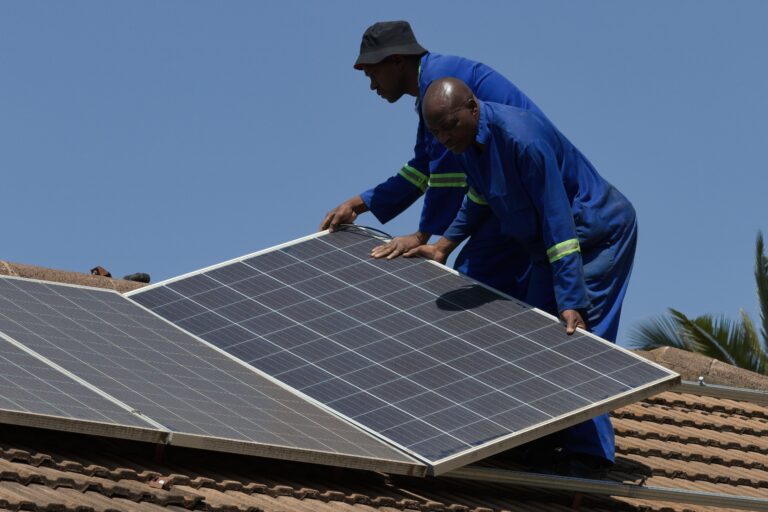
Decentralized renewable energy technologies, including mini-grids and standalone solar systems, have been crucial for households and small enterprises, as they offer the fastest and sometimes the most economical pathway to delivering electricity and improving business productivity. To truly catalyze economywide job creation, the productive use of energy programs could move beyond regional pilots to connect distributed generation with national industrial priorities—powering agro-processing clusters, logistics hubs, and special economic zones. Wherever feasible, mini-grids and distributed renewables could complement rather than substitute for national grid expansion.
5. Ensuring broad-based community benefits
Finally, past experiences show extractive patterns when it comes to new energy–industry linkages. If large-scale energy infrastructure that drives industrial development does not integrate tangible local benefits, such as household electrification, employment, community infrastructure, and domestic procurement, electrification can reinforce extractive patterns rather than reduce inequality.
Africa’s industrial future depends not just on how much power it builds but on how it connects power to productivity. Anchoring electrification around inclusive, job-creating industries could turn today’s dual challenge of supplying energy to firms and families into a shared opportunity for growth.
Almost 34 million American households were considered energy insecure in 2020, with the majority foregoing food or life-saving medicine at least once in order to pay their utility bills.
At the annual round of international climate negotiations that are well underway at COP28 in Dubai—to limit global temperature rise to 1.5° Celsius—the needs of the developing world are front and center.
30 years ago last month, a brutal heatwave struck Chicago, killing more than 700 residents. As the city and much of the United States recently experienced another period of extreme heat, this anniversary serves as a reminder that heat remains one of the deadliest climate-related hazards — killing more people each year than hurricanes, floods and tornadoes combined — particularly for communities burdened by decades of disinvestment and structural barriers to health and safety.
This report explores how residents of North Lawndale, a predominantly Black and historically under-resourced neighborhood on Chicago’s West Side, experience the compounded effects of heat waves and power outages.
Reports
by Qëndresa Krasniqi, Helen Yibrah, Rachel Scheu + 2 more • July 10, 2025
Even as the U.S. pursues an energy agenda centered on achieving affordability through abundance, utilities and local governments have tools to help families navigate energy insecurities.